Improving Marine Safety With AI Enhancements

Marine operations require constant attention in an environment that rarely forgives mistakes. From unpredictable weather conditions to complex vessel handling and human limitations, safety at sea remains one of the main challenges facing the industry.
As much as regulations and technology have evolved, incidents still occur more frequently than they should and figures from the European Maritime Safety Agency confirm that in most accidents, the decisive factor is still human factors.
Current Challenges in Marine Safety
Overwhelming evidence shows that human error is the main cause of maritime incidents. EMSA data indicates that from 2015 to 2024, 64.5% of accidents were linked to human actions. When we factor in other behavioural issues, nearly 79% of investigated casualties involve the human element. Highlighting that cognitive overload, fatigue, and unclear signals are part of maritime operations.
Another important factor is the weather and its unpredictability. Unstable and rapidly changing conditions serve as a significant risk multiplier in maritime settings. Sudden storms, rough seas, strong winds, and poor visibility due to fog or heavy rain can challenge even the most experienced crews and advanced vessels. These environmental conditions can lead to serious problems, such as higher g-force impacts, vibration exposure, injury and sea sickness.
These risks are closely connected. Data shows that bad weather often increases the impact of human error, creating a “perfect storm” where complex conditions require exceptional judgment from crews who are already under stress.
The third key factor in maritime risk is the failure of a vessel's mechanical and electronic systems. These issues often arise from poor maintenance, design or manufacturing defects, and a lack of proper monitoring of critical equipment. The results can be serious, ranging from engine room fires and explosions to failures in navigation systems, which can lead to collisions or groundings.
The key question is, “How does AI improve marine safety?” This isn't a philosophical issue, but a practical one. Can intelligent systems provide the right information at the right time to help make safer decisions?
How AI Is Enhancing Marine Safety
Across the industry, AI is being used to tackle maritime challenges that have plenty of data but not enough attention. Machine-learning models process constant streams from motion sensors, engines, radar, AIS feeds, and outside weather or oceanographic sources. They spot anomalies, predict near-term risks, and turn this information into helpful advice for crews and fleet managers.
In the fields of navigation science and safety research, AI has come to play an important role in enhancing route planning, hazard detection, and decision support, particularly when models integrate multiple data sources and adjust to vessel-specific behavior.
Onboard, these AI safety features deliver tangible, real-world benefits in marine environments:
- Anticipatory awareness: AI forecasts sea conditions and predicts how vessels will respond, offering recommendations for safe and efficient speed or course adjustments before potentially damaging impacts occur.
- Human-in-the-loop coaching: By identifying risky handling patterns, often caused by fatigue, poor visibility, or complex maneuvers, AI provides timely corrective guidance, helping prevent incidents while keeping operators in full control.
- Predictive maintenance: Subtle changes in vibration, temperature, or fuel consumption can signal potential equipment issues. AI detects these early, enabling maintenance to be carried out in port rather than mid-ocean, reducing the risk of unexpected failures.
These same capabilities are already bringing measurable benefits and improvements to marine safety such as lower emissions, fewer “near misses,” and better fuel efficiency. This proves that safety and operational performance support each other.
Hefring Marine’s AI-Powered Solutions
IMAS® offers a clear example of how AI technologies come together in a proven, real-world solution. Hefring Marine’s approach centres on the Intelligent Marine Assistance System (IMAS®) as an overarching, AI-driven platform designed to support safer, more efficient marine operations. Marine safety is a key outcome of the IMAS® ecosystem, alongside performance, efficiency, and operational insight.
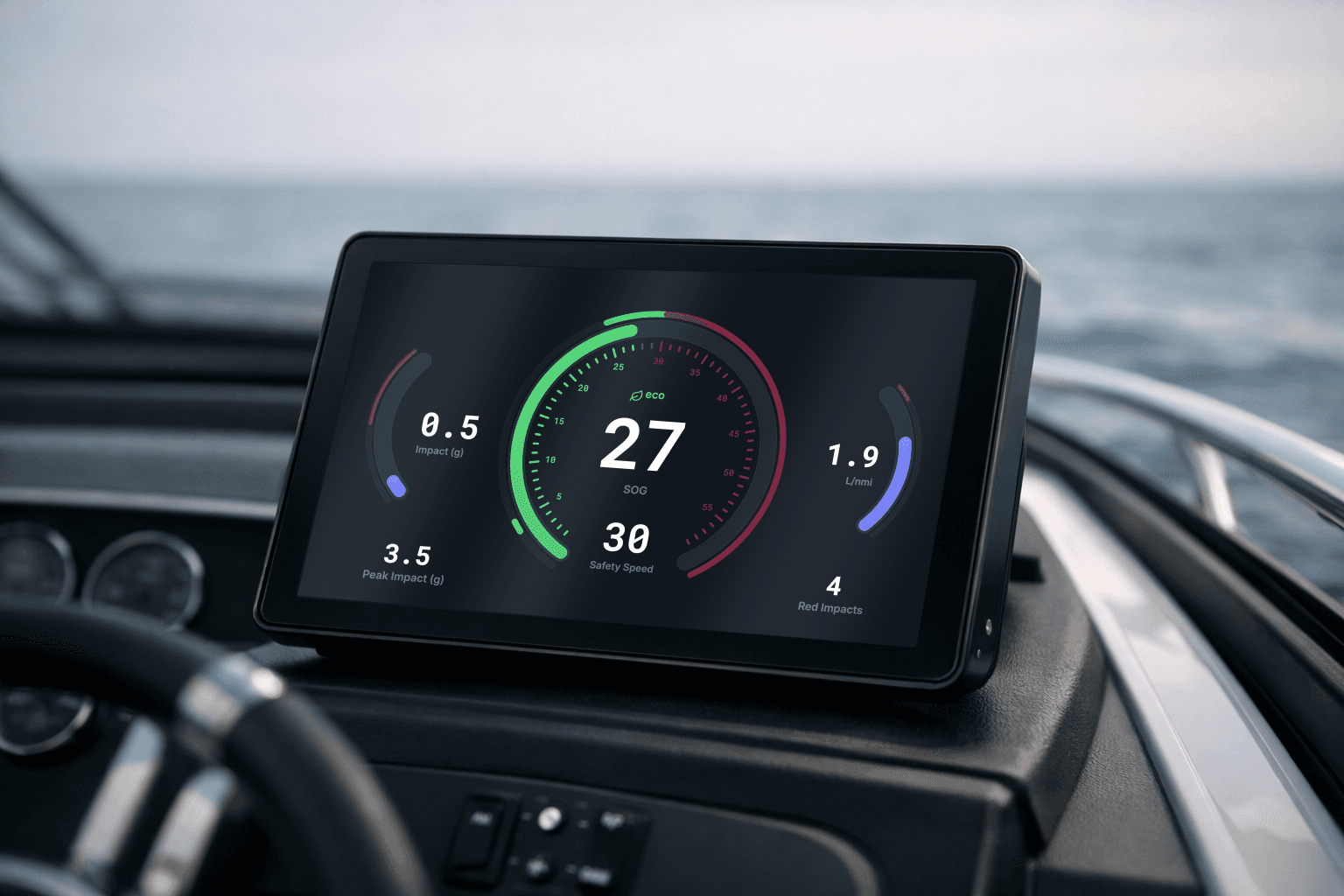
At the core of the platform is IMAS Helm®, an onboard, AI-powered digital assistant that provides real-time decision support to vessel operators. This connects to IMAS Console®, a cloud-based onshore platform that equips fleet managers with tools for real-time monitoring and in-depth analysis. The ecosystem is completed by the IMAS® App, which extends fleet visibility and operational control to mobile devices, ensuring continuous connectivity.
The IMAS® platform converts complex operational and environmental data into clear, actionable insights through advanced marine AI safety features such as SafetySpeed, EcoSpeed, Intelligent Impact Analysis, Live Vessel Monitoring, Rules and Alerts, Fleet Insights, and Statistics.
Using the IMAS® system has led to real, data-supported results for clients. Documented improvements include reductions of up to 20% in fuel use and CO₂ emissions, alongside a decrease of up to 87% in wave slamming impacts. These results demonstrate that AI-driven safety is not just about risk reduction; it also delivers measurable operational and financial returns.
Artificial Intelligence (AI) is now transforming how these risks are managed. At Hefring Marine, we are leading this shift by providing advanced AI-driven solutions that integrate real-time vessel and environmental monitoring, predictive insights, and operational optimisation. By interpreting complex data streams and delivering actionable guidance, IMAS® enables crews and operators to make faster, smarter, and safer decisions, helping to prevent accidents before they happen and setting a new benchmark for safety across the maritime sector.
The Benefits of AI for Marine Safety
AI-powered safety systems such as IMAS® create a series of operational, financial, and human benefits that change how vessels are managed. They mitigate human error and improve crew performance by providing data-driven recommendations that help prevent mistakes due to fatigue, stress, or inexperience. By automating routine monitoring, IMAS reduces cognitive load, allowing crews to focus on higher-level decisions. This technology supports human expertise, making teams more capable and resilient, ultimately leading to many marine safety enhancements.
AI also improves operational efficiency and extends asset life. Optimized routes and speeds help avoid hazardous conditions, decrease fuel use, and reduce emissions. Predictive maintenance stops equipment failures that could lead to costly downtime.
This leads to a cycle of improvement. For example, an AI system that suggests a speed reduction to mitigate heavy wave impacts is making a key safety intervention. This single decision triggers several positive effects: it lowers the immediate risk of crew injury and structural damage, reduces long-term wear on the hull and equipment, optimizes engine performance for the conditions, cuts fuel use and related emissions, and contributes to a record of safer operations that may result in lower insurance premiums.
Investing in AI marine safety enhancements is far more than a one-time cost. It is a strategic investment that drives efficiency, reduces risk, and delivers measurable savings across various aspects of maritime operations.
The Future of AI in Marine Safety
Looking ahead, three trends stand out. First is context-aware autonomy, where AI-guided automation will increasingly support various industries, with sea-state-responsive controls that reduce impact exposure. Second is fleet-to-infrastructure intelligence sharing, in which ports, VTS systems, and fleets exchange model outputs rather than raw data to create shared situational awareness without adding to crew workload. Third is explainable AI for the bridge, providing clear recommendations that build operator trust.
Market forecasts reflect this growth, with maritime AI expected to grow at nearly 40% CAGR through 2030.
So, what is AI and how can it improve the maritime industry? In this context, AI refers to systems that learn from data patterns and apply those insights to new situations, whether optimizing routes in changing weather, predicting engine behavior, or helping human operators in complex scenarios. Its real value lies in reducing sense-making time in environments where every second matters.
Conclusion
AI is revolutionising maritime safety by providing a structured, data-driven approach to persistent risks such as human error, environmental changes, and mechanical failures. By shifting the industry from reactive responses to predictive decision-making, AI marine safety enhancements help prevent accidents while boosting efficiency, reducing costs, and supporting sustainability.
Hefring Marine is at the forefront of this transformation. Its integrated IMAS® platform combines advanced marine AI safety features with real-time monitoring, predictive analytics, and operational insights to deliver proven, tangible results. Supported by a growing network of partners across search and rescue, autonomy, insurance, and training, Hefring Marine goes beyond being a technology provider, it is a driving force behind a safer, more efficient, and more sustainable maritime future, setting the standard for marine safety enhancements across the industry.
To see how these capabilities map to your mission, contact our specialist team today to unlock your fleet's full potential.