How RibSafari runs safer, smoother and more economical tours with IMAS
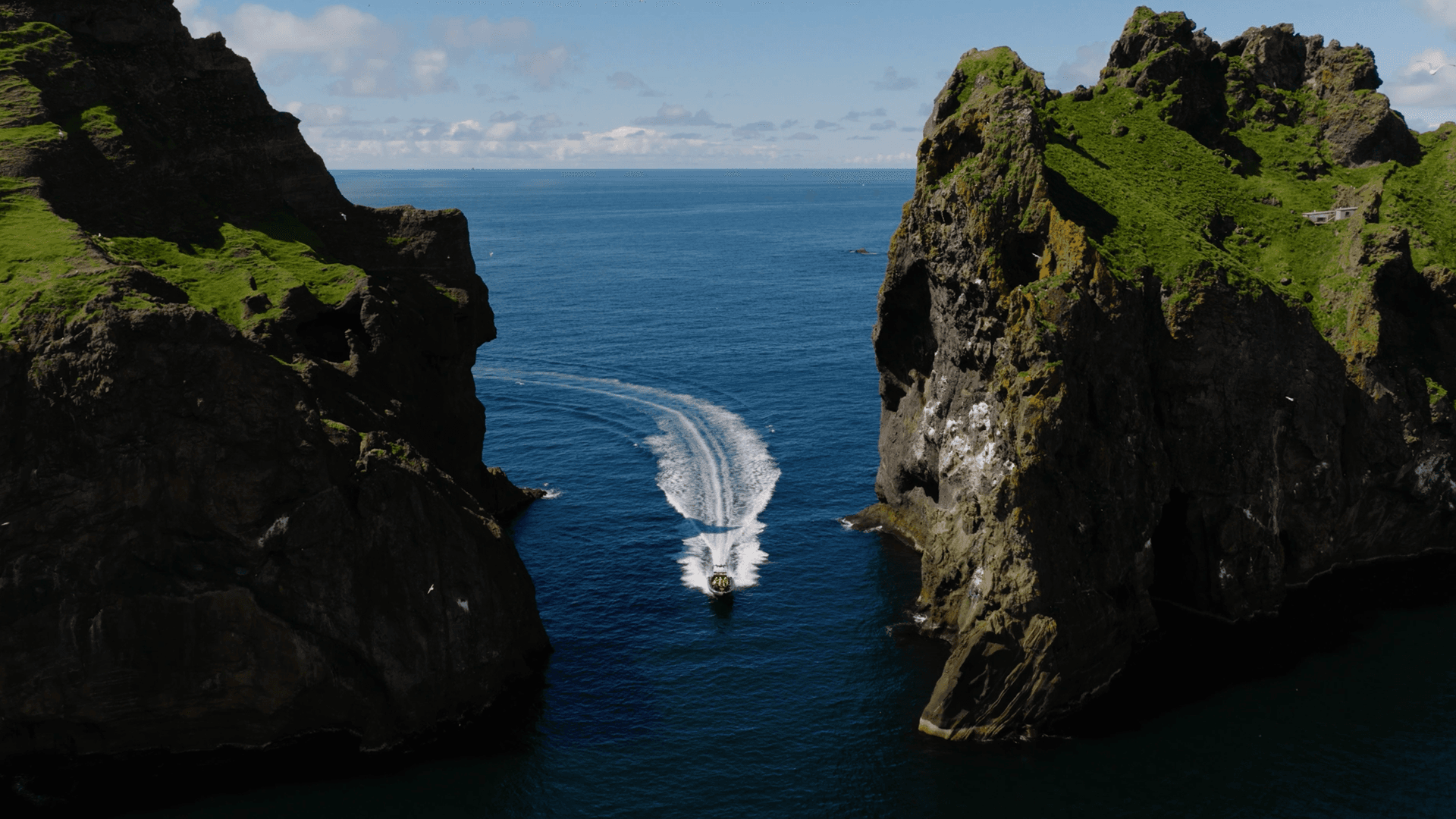

We caught up with RibSafari on a sunny day in Vestmannaeyjar to hear how they manage a high-speed RIB operation in exposed North Atlantic waters.
RibSafari have used IMAS since April 2024 to give their captains a clearer reference at the helm, improve consistency across the fleet and build a record of what every vessel experiences on the water.
Their captains explain how that has helped them protect passengers and crew, manage fuel consumption and give the team ashore a much clearer view of every trip.
"The system that we used before was just our gut."
RibSafari run passenger tours of caves, coastline and wildlife, several sailings a day in volatile conditions. The water is demanding. Swell arrives from the open North Atlantic, waves reflect off steep cliffs and conditions can change in a moment.
The difference between a memorable tour and an uncomfortable one comes down to a throttle decision made every few seconds, by a captain who is also navigating, talking to passengers and reading the sea. Until April 2024, those decisions were made on feel alone.
Every experienced captain can sense an impact as it happens, but felt from the helm and experienced at the bow are very different things. Feel also cannot tell you whether this morning's tour was harder on the hull than yesterday's. It cannot reliably compare one captain with another, or this season with the last. It leaves nothing to review with a new captain and nothing objective to put in front of an insurer, regulator or commercial client who asks how risk is managed.
Since April 2024, IMAS has continuously measured vessel motion across RibSafari's fitted boats and recorded the impacts their hulls experience.
- 2000+ trips
- More than 2,400+ hours underway
- 23,000+ impacts above 1g
Running quickly in a following sea, a captain is answering two questions at once:
How fast can we go without putting passengers, crew and equipment through excessive impacts?
How fast do we need to go to finish the tour on schedule without burning fuel unnecessarily?
The answers are rarely the same, and both move with the conditions.
SafetySpeed reads the conditions the vessel is actually experiencing and recommends a speed that keeps impacts within defined limits.
It is guidance, not a governor. The captain retains full command, but gains a consistent reference that does not depend on fatigue or years of experience.
EcoSpeed addresses the other half of the problem by helping the captain complete the passage on time with the lowest practical fuel consumption.
RibSafari's captains work from both readings on the helm display. Over time, the numbers become a shared language. Crews learn what a given figure feels like at a particular speed, hold a more consistent profile and ease off before the impact rather than reacting afterwards.
Fuel consumption is one of the operating costs most directly affected by throttle behaviour. Without an objective reference, speed tends to be managed through a series of intuitive corrections. Accelerate, encounter a harder section of water, slow down, then accelerate again.
With SafetySpeed and EcoSpeed providing a baseline, the same tour can be run with a more consistent speed profile and fewer unnecessary changes in throttle.
Across IMAS deployments, operators have recorded fuel reductions of up to 20%.
The principle is straightforward. Reduce unnecessary acceleration, avoid losing speed through severe impacts and treat fuel consumption as something that can be actively managed rather than discovered at the pump.
Route and hazard intelligence: what the season looks like from ashore
Every RibSafari trip is recorded and can be reviewed in IMAS Console, turning thousands of individual decisions at the helm into information the wider operation can use.
Impacts are recorded against position, so patterns emerge that no single captain would necessarily see from the helm. A headland that regularly throws back reflected swell. A section of route that becomes unpredictable in a particular sea state. A location where repeated impacts suggest the crew should approach differently. RibSafari can review those patterns against its tour routes and build a more detailed picture of the water around the islands.
Management can also see how each trip was run, which makes throttle discipline something that can be reviewed and coached rather than assumed. A captain in their first season starts from what the fleet already knows, rather than building the same knowledge independently over several years.
And when an insurer, regulator or commercial client asks how risk is managed, the answer is supported by a record of where vessels travelled, what they experienced and how trips were run.
Identifying problems earlier
Recording an impact tells an operator what the vessel experienced. Identifying its consequences early can prevent that event from becoming a more expensive failure.
IMAS continuously monitors vessel sensor data and can flag anomalous readings that may indicate a developing issue, so the crew can investigate when the change first appears rather than waiting for the next scheduled service. Where the data suggests an impact may be associated with a particular part of the vessel, such as a possible propeller strike, IMAS can prompt the operator to inspect.
For a seasonal passenger operation, unplanned downtime is more than a maintenance cost. It can mean cancelled tours, refunded bookings and lost operating days during a short season.
From measuring impacts to avoiding them
IMAS does not only record what has already happened. Its predictive guidance evaluates 27 combinations of speed and course across five time horizons, projecting conditions up to 120 seconds ahead and recalculating every second. The aim is to help the captain avoid the impact in the first place, rather than simply measure it afterwards. Across IMAS deployments, operators have recorded up to 93% fewer vessel impacts.
See what your operation looks like measured
Tell us how and where you operate, and we will show you what IMAS records on a vessel like yours.